Find out what to
build first.
Every project starts with discovery. Papercuts is how we find the small problems your people work around.
 Watch · 1:48Papercuts in under two minutes
Included with every Runpoint AI build, or bought on its own.

“Before I cut anything, I text drafting to check the drawing is current.”
Papercut logged
What two weeks of discovery gets you.
- 123
Know what to build first
Every papercut ranked, and one clear first project.
Build on how work really runs
Maps of today's process and a better one.
Skip software you don't need
Some fixes need software. Some just need a phone call.
- What we heard
Bring your team with you
Everyone hears what we found and what's next.
You keep: the papercut catalog, process maps, a coverage statement, ranked fixes, a first build plan, and a team update.
Then we sit down with you, walk through the three strongest opportunities, and recommend which one to build first.
A good plan needs both versions of the story.
Leaders know how the process should run. The people doing it know what really happens.
ExecutiveEstimating reprices it, and the project manager approves it.
EstimatorI reprice it and send it to the project manager.
EstimatorI repriced it, but first I checked my own spreadsheet, because the price list in the system is out of date. Then it went to the project manager. When it's a rush I walk it over. Otherwise it can sit in his inbox for days.
In person first, then an easy way to send every papercut.
- 01
Talk in person
One at a time, on paid time. This is where people tell us the real story.

- 02
Send papercuts as they happen
From the phone app, by email, or from Chrome. Whatever is closest when something gets in the way.
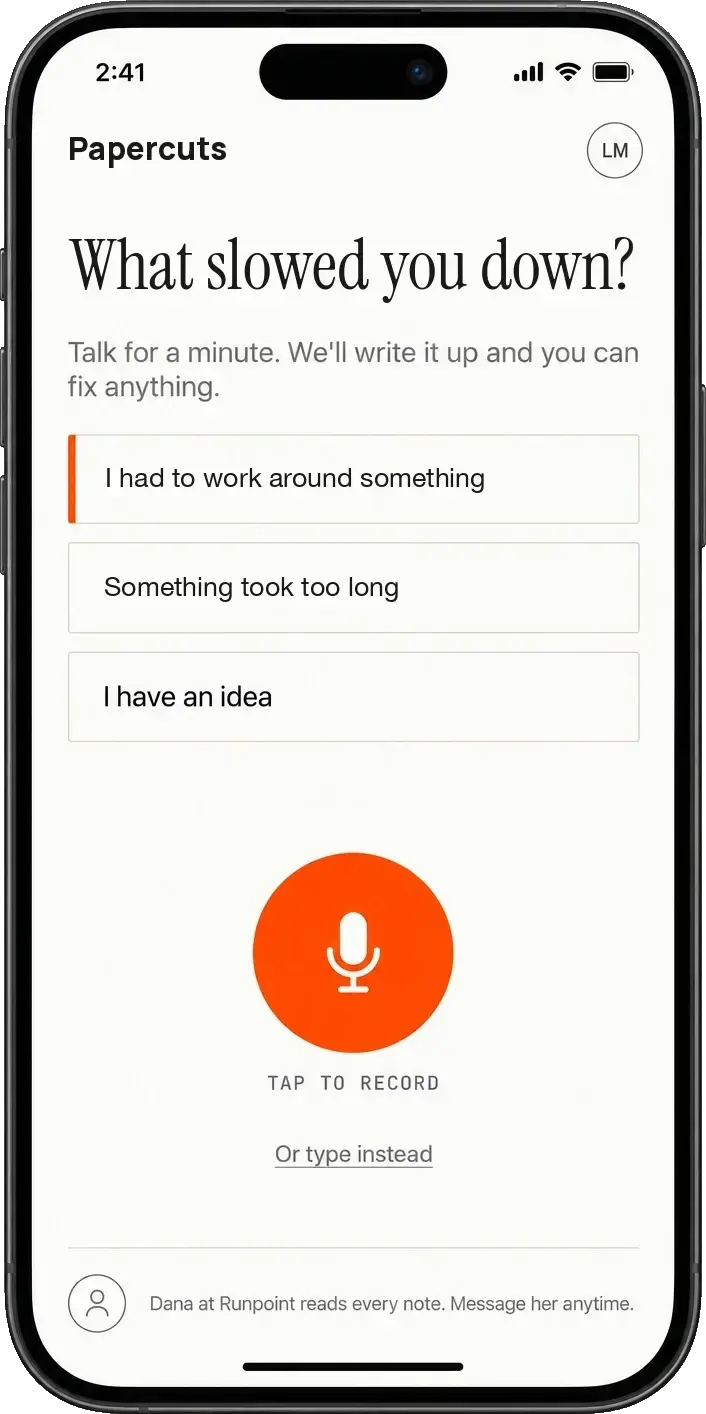
2:41PapercutsWhat slowed you down?
Talk for a minute. We'll write it up and you can fix anything.
I had to work around somethingSomething took too longI have an ideaTap to recordOr type insteadDana at Runpoint reads every note. Message her anytime.
Try it: tap through a real note
Sample content
- 03
Catalog and triage
AI transcribes and sorts every papercut. We check where people disagree and rank what to fix.
Everything people tell us ends up in one place your leaders can see.
Try it: click through what your leaders see Papercuts/Sample fabrication companySample dataChange order to shop release, today
27 accounts22 verified4 workaroundsUpdated todayStep 2 · EstimatingWorkaround: Estimator checks a personal pricing spreadsheet first. The price list in the system is out of date.Reported by 4 people · Not in any system
Where this came from- Estimating, voice note
- Estimating, conversation
- Project management, conversation
Pick where you want to start.
The team that listens is the team that builds. The findings are yours either way.